RAD Campaign and Women Who Tech commissioned a nationally representative poll of 1,015 U.S. adults (18+) to understand Americans' concerns about artificial intelligence (AI). The findings show that Americans are more concerned about AI's use in deepfakes, election disinformation, and the sexualization of women and children than its impact on jobs or the economy.
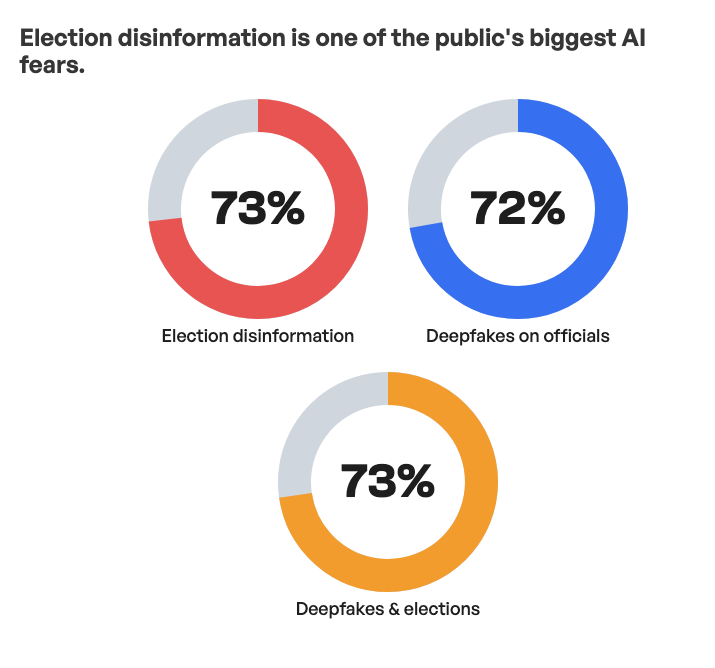
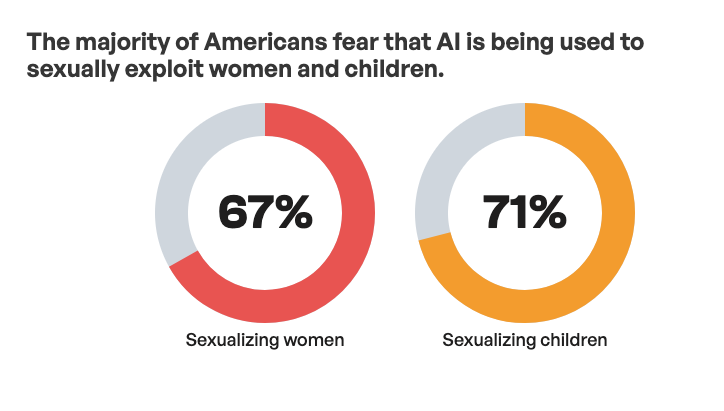
Overall, 71% worry about AI-generated deepfakes and disinformation affecting elections, while 67% are concerned about AI being used to sexualize women. Respondents also identified Tiktok and X as the leading source of AI misinformation.
Visit the full AI Poll Data experience to explore the data by gender, age, race, political affiliation, region, and more to see how views on AI vary across politics, culture, work, and the economy.
Key Takeaways
With artificial intelligence rapidly transforming online culture, its use to impersonate politicians, influence elections and sexualize women and children is a source of widespread worry among Americans.
Anxieties over AI disinformation and abuse cross party lines—a rare, clear bipartisan/nonpartisan issue—suggesting a mandate for officials to act.
AI's Influence — Elections & Culture
As 2026 midterm election campaigns enter full swing and online culture is being flooded with AI slop, Americans are expressing deep concerns about AI-generated election-related disinformation and deepfakes, according to a new survey from Women Who Tech and RAD Campaign, published at:
The poll data shows the American public strongly favors guardrails around how artificial intelligence is used, especially when it comes to politics and elections, and the sexual exploitation of children and women. Overall, Americans are registering more concern and skepticism than confidence and enthusiasm over the uses and effects of AI.
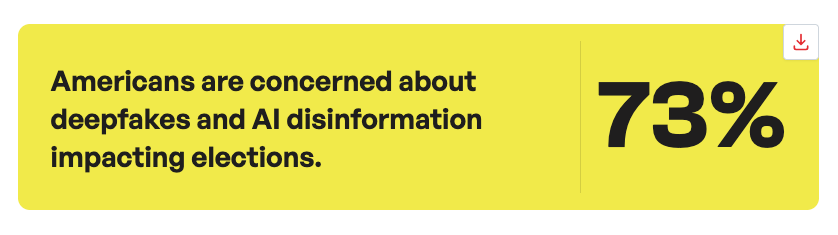
Election-related disinformation generates especially intense concern: About half of respondents, 49%, are “very concerned” about AI spreading disinformation ahead of the upcoming midterm elections in November, and 73% indicated some level of concern about it.
And 81% favor either requiring disclosure of AI-generated content (42%) or prohibiting its use on official government accounts (39%). Only 19% believe politicians should be free to use AI-generated content on social media without restriction.
The poll also provides extensive demographic breakouts. For example, college-educated respondents (50%) and registered voters (47%) show higher concerns about AI misuse in politics than those who are not college educated (41%) or not registered to vote (35%), and independent voters are less concerned (35%) than registered voters of both major political parties (Republicans 45%, Democrats 50%).
Social media users overwhelmingly report seeing about the same amount of or more politics-related misinformation and disinformation on platforms than a few years ago: 93% of users say they see the same amount or more on Instagram; those numbers are 91% for Facebook, 90% for YouTube, 88% for X, and 87% for TikTok.
According to poll results, Americans feel that Big Tech has not done nearly enough to curb misinformation on social platforms. About half of all social media users associate the major platforms with increased misinformation or disinformation: 51% on X say it has become “more” or “a lot more” common recently, with similar numbers for Instagram (48%), TikTok (48%), and Facebook (47%).
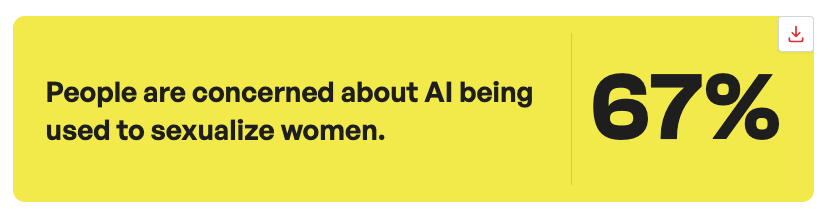
One of the strongest areas of concern is the use of AI to create sexual content targeting women and children: 71% register some or high concern about AI deepfakes that sexualize children, and 67% have some or high concern about AI being used to create sexual imagery of women.
The poll was conducted June 13-18, 2026 and comes in the wake of the enormous Grok sexual deepfake scandal, in which X (formerly Twitter) users flooded the platform with AI-generated sexual imagery, mostly of women and children.
Deepfakes are widely recognized as a form of sexual harassment or assault. While there is broad public support and backing from high-profile celebrities and advocates such as Paris Hilton, federal efforts to address the issue have had limited impact so far. The TAKE IT DOWN Act took effect on May 19, 2026, making it too early to assess its effectiveness. The DEFIANCE Act passed the Senate last January and has since remained pending in the House.
"One of the most striking findings from the poll is that Americans are far ahead of policymakers and technology companies on this issue," said Allyson Kapin, Founder of Women Who Tech and Founding Partner at RAD Campaign. "People overwhelmingly reject the idea that politicians or platforms should be able to use AI without meaningful safeguards. And they want transparency, accountability and stronger protections against AI being used to spread election disinformation and nonconsensual sexual deepfakes.”
This poll also captured results on political engagement on social media, levels of optimism about AI, frequency of personal AI usage by demographic, and levels of optimism and pessimism about how AI will affect people’s jobs, companies and the economy
See the full poll results, data visualizations and methodology